Using data from 168 source countries spanning 2000 to 2024, we examine the determinants of inbound tourist arrivals in Seychelles. We find that past travel experience, origin country income, destination visibility, and air connectivity are the primary drivers of tourist arrivals. The income effect is asymmetric: arrivals respond to income gains but are resilient to declines. This pattern is consistent with a compositional mechanism, whereby rising incomes draw newly affluent travellers into the market while moderate declines leave Seychelles' wealthy core clientele largely unaffected. Disaggregating by region of origin reveals substantial heterogeneity: income accounts for 57.8 and 80.4 per cent of explained variation in arrivals from Europe and Africa respectively, while past travel experience accounts for 84.4 per cent of explained variation in Asian arrivals, pointing to a mature and loyal source market. These findings highlight the importance of visitor experience quality, targeted digital marketing, and air access development as policy levers for small island tourism destinations.
Neron Sifflore
Abstracts and selected figures from working drafts and in-progress projects.
Working papers
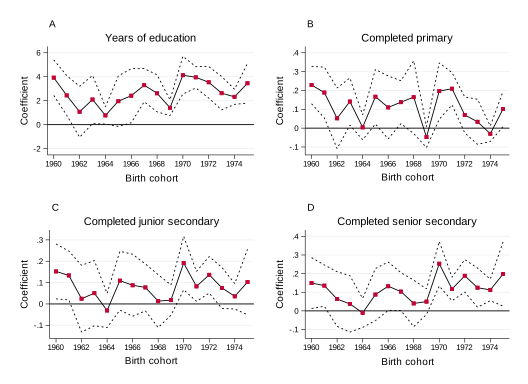
In 1976, Nigeria introduced its free education programme that abolished fees in all public primary schools. Using data collected 33 years after the scheme's introduction, we estimate its impacts on educational attainment, learning, and employability. We find the programme increased men's educational attainment by one year but had no measurable effect on their learning; it also increased the probability of a woman completing primary school by 36.8 percent. We find no evidence that the programme improved employability. If anything, it seems to have reduced male participation in agriculture, but we find no evidence of increased participation in skilled jobs.
In progress
In 2018, John Magufuli, then president of Tanzania, publicly condemned the use of contraceptives by women and encouraged larger families during a rally speech. Using a difference-in-differences strategy that exploits variation in a woman's age at menarche and regional variation in exposure to the speech, I examine the effects of these persuasive messages on fertility outcomes.
Between 2016 and 2023, Nigerian states phased in the National Home-Grown School Feeding Programme, which offered free meals to Grade 1–3 children in public primary schools. Exploiting variation in (i) the timing of programme introduction across states and (ii) cohort exposure, I estimate the programme's effects on primary school completion, enrolment, and grade progression.